
Water-related disorders
Water is the cause of the majority of construction disorders. Beyond the classic waterproofing defects, several hydrogeological phenomena can cause serious damage to structures, sometimes several years after commissioning.
1. Karst cavities and dissolution
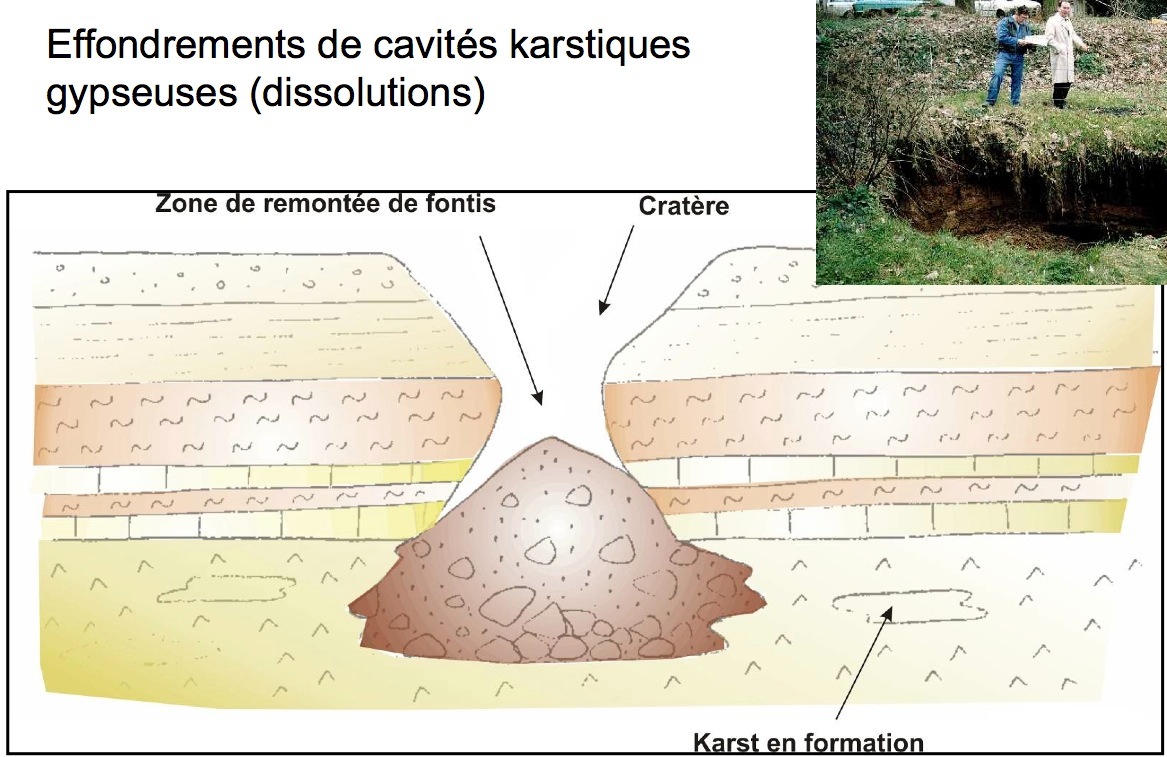
Some rocks are soluble in water and can form underground cavities (karst). The main rocks concerned:
- Limestones (CaCO₃) — slow dissolution, formation of large-scale cavities (Causses, Jura, Vercors)
- Gypsum (CaSO₄·2H₂O) — rapid dissolution, particularly worrying in the Paris region (Bartonian, Lutetian)
- Rock salt and evaporites — highly soluble
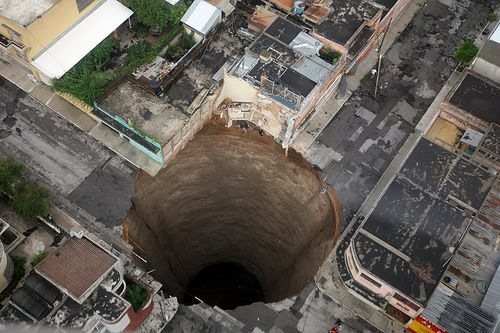
The collapse of a cavity produces a sinkhole (fontis) at the surface — a sudden subsidence that can swallow buildings. Known risk zones are mapped by the BRGM (Géorisques); in the Paris region, the Inspection Générale des Carrières (IGC) keeps a register of man-made cavities (former gypsum and coarse-limestone quarries).
2. Water-table variations
The level of a water table varies naturally over time:
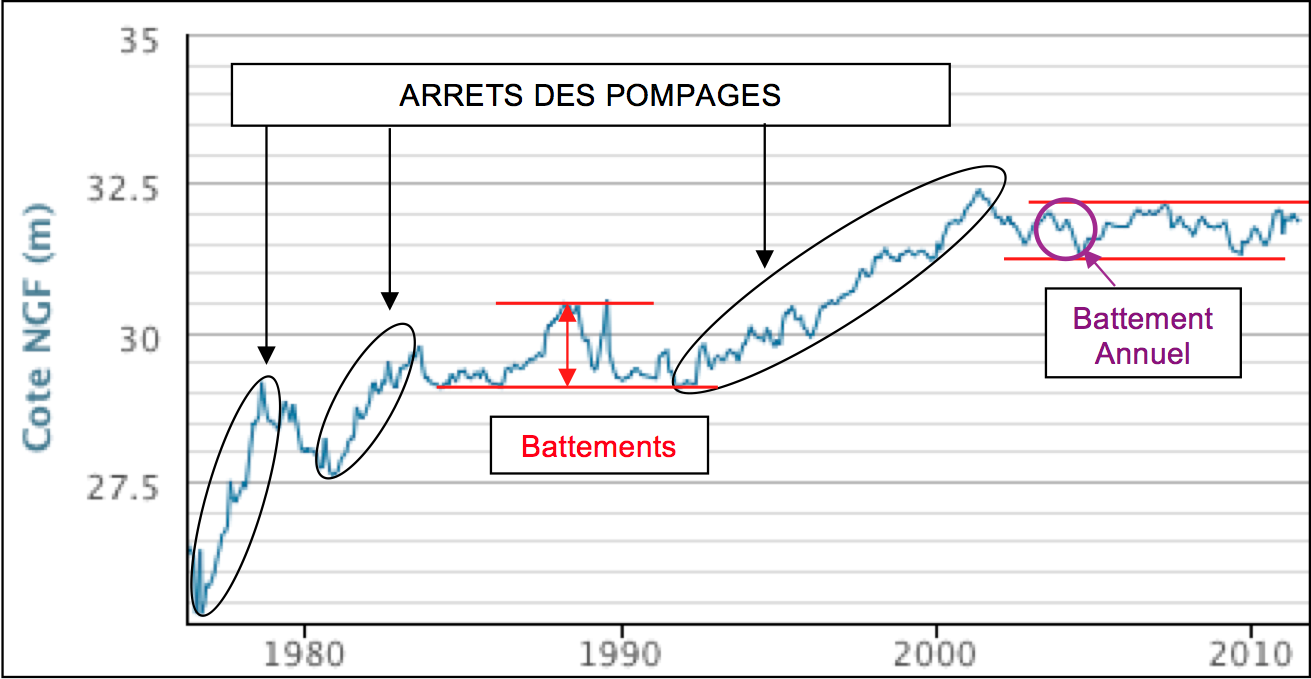
- Seasonal variations (winter recharge, summer low water) — typically 1 to 3 m
- Exceptional cyclical variations (rainy episodes such as the Somme in 2001, the Île-de-France in 2024) — several metres of rise
- Structural variations linked to urbanization (changes in soil sealing, stopping of industrial pumping such as in Paris in the 1980s)
Consequences for buried structures designed for an underestimated water-table level: flooding of basements, unforeseen uplift, infiltration.
3. Groundwater lowering
Groundwater-lowering works (construction or operation) can generate two major types of disorder:
- Settlement by hydraulic consolidation — the drop in pore pressure increases the effective stresses in nearby compressible layers, which settle. Buildings on shallow foundations nearby experience settlement that is sometimes differential.
- Washout of fines — flows towards the pumping carry away the finest particles of granular soils, creating decompressed zones that can cause cascading subsidence.
4. Uplift (buoyancy)
Water from the table accumulated against buried structures exerts an Archimedes thrust that tends to make the structure rise (buoyancy). This uplift can reach several tens of kPa per metre of water above the raft.
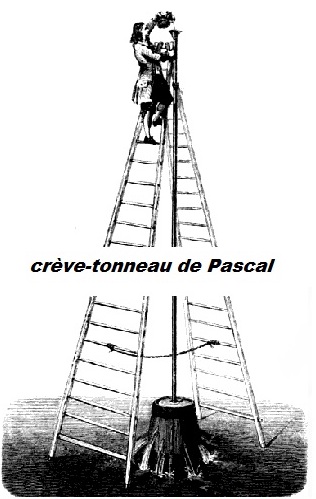
This is the principle of Pascal's barrel: a small quantity of water in a vertical tube exerts a great pressure below, regardless of the total volume.
Typical disorders:
- Uplift of the raft in the event of atmospheric depression or rapid water-table rise
- Cracking and disorders after excavation of terraces that ballasted the building without recalculation
- Reinforcement deficit of the raft underestimated at the design stage
The design against uplift must take into account the extreme water-table levels (100-year) and provide sufficient ballast or anti-flotation anchors.
5. Soil liquefaction
If a saturated granular soil is subjected to vibrations, the pore pressure can become greater than the soil pressure. The effective stresses cancel out and the soil loses all its strength — this is liquefaction. Foundation failure can be instantaneous.
This phenomenon is encountered at two scales:
- During earthquakes — a major risk in seismic zones on saturated sandy soils (studied by the methods of Seed-Idriss, Boulanger)
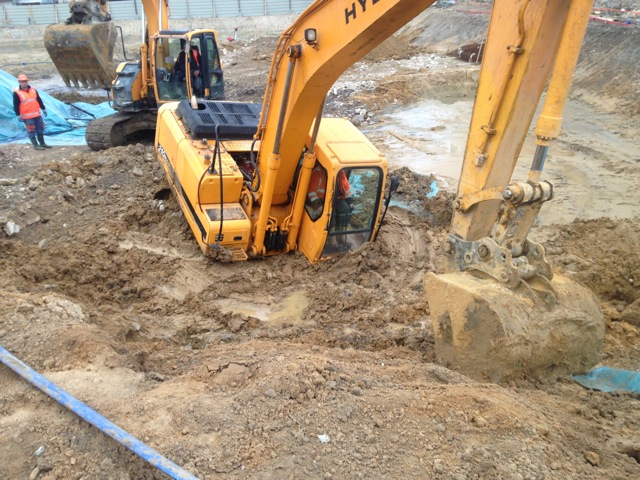
- During construction — when machinery moves over water-soaked silty sands, forming entire sectors of “quicksand”
6. Chemical attack of concrete
Some groundwater contains elements that are aggressive to concrete:
- Sulfates (SO₄²⁻) — formation of expansive ettringite, disintegration of the cement
- Aggressive CO₂ — decalcification, leaching
- Acids (H₂SO₄, H₂S) — direct chemical attack
- Pure water (weakly mineralized) — dissolution of the cement lime
Historical example: near the Pont de Neuilly, a strong smell of H₂S emanated from a sump collecting drain water. An alteration of the concrete on the inner surface of the perimeter wall had been discovered in damp zones corresponding to groundwater infiltration.
7. Poor execution of protection structures
Several causes of recurrent disorders:
- Plain absence of drainage — the n°1 cause of basement disorders
- Drains buried in impervious backfill — ineffective drainage
- Clogging of the structures by migration of fines (absence or failure of the filtering geotextile)
- Concreting joint with a defective seal — preferential infiltration paths
- Cracking of the structures in concrete
Appendix — Cracking of concrete
Cracks in buried concrete are preferential infiltration paths. Several causes:
- Plastic shrinkage — evaporation of the mixing water before setting (shallow surface cracks)
- Drying shrinkage — progressive drying after setting (deeper cracks, sometimes through-going)
- Thermal shrinkage — cooling after the heating of cement setting
- Autogenous shrinkage — internal water consumption by cement hydration
- Deficient reinforcement — undersizing of the skin reinforcement